HTTP Storage
HTTP Storage is an adapter for connecting storage that does not expose an S3 or WebDAV interface to Office. When a storage service implements an HTTP Storage Provider, Office reads and saves documents through signed HTTP requests.
Run a Provider
The public example repository provides complete servers implemented with Node.js, Spring Boot, and FastAPI, along with sample documents. Each example uses a local directory on the Provider as storage and supports all protocol operations by default.
Install Node.js and run the following commands. The Provider runs on port 9090 to avoid a conflict with Office on port 8080.
git clone https://github.com/thinkfree/http-storage-provider.git
cd http-storage-provider
npm install
npm run init
TFO_STORAGE_HOST=0.0.0.0 TFO_STORAGE_PORT=9090 npm start
npm run init creates local configuration and prints the adapter name local-directory and a generated request signing secret. Use both values in the admin page. Configure the same secret in Office and the Provider, and keep it out of source code and logs.
These commands bind to network interfaces so Office in another container can connect. For Provider base URL, use a server IP address or DNS name reachable from Office, with port 9090. Inside an Office container, 127.0.0.1 refers to that container itself, so it cannot identify a Provider running on the host. Use HTTPS outside a trusted network.
In a separate terminal, run the following command from the same directory.
TFO_STORAGE_PORT=9090 npm run smoke
If you see Signed listing succeeded and the sample filenames, the Provider has successfully answered a signed listing request.
Provider examples in other programming languages
In addition to Node.js, the Git repository includes Provider examples using Spring Boot in Java and FastAPI in Python. Choose an example for your programming language and follow its guide for setup and configuration.
| Implementation | Working directory and command | Setup guide · Contract tests |
|---|---|---|
| Node.js | Run the commands above from the repository root | Guide · test/app.test.mjs, npm test |
| Spring Boot | ./run.sh in examples/java | Guide · HttpStorageProviderApplicationTest.java, mvn test |
| FastAPI | ./run.sh in examples/python | Guide · test_app.py, .venv/bin/python -m unittest -v |
Spring Boot requires Java, Maven, and OpenSSL. FastAPI requires Python, venv, and pip. Both examples default to port 8080. Change the port and bind address in the configuration file created on first run, then restart. Java uses TFO_STORAGE_PORT and TFO_STORAGE_HOST in .env.java; Python uses port and host in .provider-config.json.
Register an HTTP Storage adapter in Office
-
Sign in to the Office admin page.
-
Under External linkage, click Add Adapter and select HTTP Storage as the type.
-
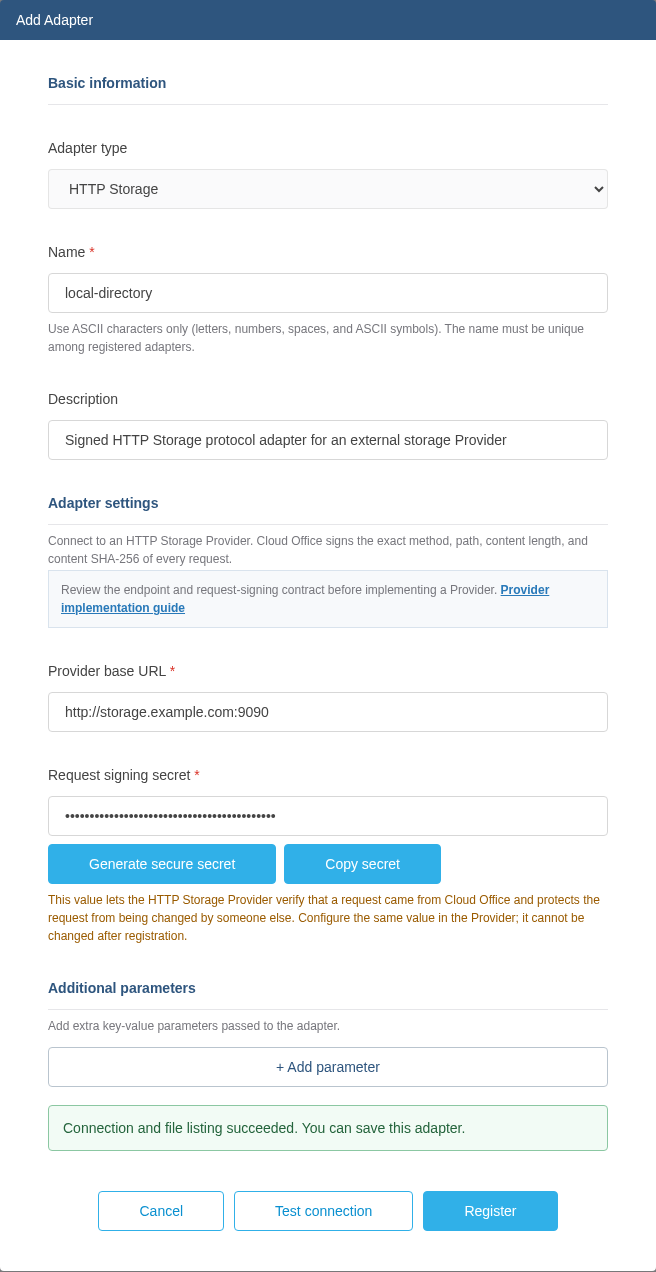
Enter the following values. This example uses
storage.example.comand port9090for the Provider server. Replace the example domainstorage.example.comwith an actual server IP address or domain reachable from Office.Field Value Name The adapter name configured in the Provider. The Node.js example uses local-directoryProvider base URL http://storage.example.com:9090. Do not append/tfo-storage/v1or a document pathRequest signing secret The value generated by npm run init. Enter the same secret configured in the Provider -
Run Test connection. When a message confirms a successful connection and file listing, as shown below, click Register. Check that
local-directoryappears as Running in the adapter list.
The following screenshot shows the Node.js example values after a successful connection test. The request signing secret is masked.
Open Browse files for the registered adapter to view the Provider's documents. The Node.js example includes sample.docx, sample.xlsx, and sample.pptx in its samples directory.
The connection test calls list at the Provider root. If the Provider does not implement listing, you can register it after acknowledging that file browsing is unavailable only when it returns the exact LIST_NOT_SUPPORTED response. Resolve authentication failures and other connection errors first.
The request signing secret is a shared secret that Office uses to sign requests and the Provider uses to verify them. Configure the same value on both sides. The Provider verifies the signature and the actual request contents to detect tampering.
The adapter name and request signing secret cannot be changed after registration. To use different values, configure them in the Provider and register a new adapter with matching values.
Create a document URL
An Office URL contains the registered adapter name and the document path relative to the Provider's storage root. Use the following address to open storage/samples/sample.docx from the Node.js example. If your Office address or port differs, replace http://localhost:8080 accordingly.
| Field | Value |
|---|---|
| Office address | http://localhost:8080 |
| Name | local-directory |
| Provider storage root | storage/ in the example repository |
| File on the Provider | storage/samples/sample.docx |
| Document path in the URL | samples/sample.docx |
Append /cloud-office/api/, the adapter name, the path relative to the storage root, and /open to the Office address.
http://localhost:8080/cloud-office/api/local-directory/samples/sample.docx/open?app=WORD_EDITOR&user_id=test-user&docId=httpsample001
Do not include storage/, which is the Provider's local root, or the Provider base URL entered in the admin page in the Office URL. Office uses the Provider address when sending the protocol requests described below. URL-encode each path segment containing spaces or non-ASCII characters. Set user_id to the user identifier and docId to a unique alphanumeric document identifier. See Create document URLs for app values for each file type and all options.
When Office opens the document, it sends requests to a separate protocol URL on the Provider.
Provider base URL: https://storage.example.com
Document path:     samples/sample.docx

GET https://storage.example.com/tfo-storage/v1/samples/sample.docx/info
GET https://storage.example.com/tfo-storage/v1/samples/sample.docx/get
Implement your own Provider
To implement a Provider, understand the document lifecycle of opening, editing, saving, and closing a document in Office and the role of each operation below. Office uses info to retrieve document information and get to download its contents when opening it. It uses put to save the edited document to storage. If you provide locking, use lock and unlock to lock and unlock documents during editing.
When building on an example, replace the filesystem read and write operations with calls to your storage API. Retain request authentication and path validation. See HTTP Storage Protocol for the complete request and response contract.
| Operation | Purpose | Implementation scope |
|---|---|---|
info, get | Retrieve document information and download documents | Required to open documents |
put | Save the complete edited document | Implement if you provide saving |
list | List the immediate children of a directory | Implement if you provide file browsing |
lock, unlock | Lock and unlock documents | Implement both or declare both unsupported |
mkdir, rename, delete | Create directories, rename entries, and delete entries | Implement the features you provide |
Process requests in the following order.
- Check the request method, path, body format, and size. Buffer uploads in temporary storage while calculating their actual length and SHA-256 digest.
- Verify the JWT signature and validity period, adapter name, and actual method, path, and body information. Reject reused request IDs.
- Check document access permissions for the authenticated request, then perform the storage operation. For an unsupported optional operation, return its exact
501response. - Send the actual byte length in
Content-Lengthforinfo,list,get, andputresponses. For saves, replace the target file only after body verification completes, then return a JSON object containing only the saved document'sdocId. See PUT response for its format and stable-ID rules.
The maximum sizes are 5 MiB each for info, list, and put response JSON and 300 MiB for a document. These JSON responses and get responses must not use chunked transfer or compression. See Signature verification, Response framing and size limits, and Unsupported operations for the exact rules.
Saving fails if put is unsupported. When locking is unsupported, Office treats the exact lock and unlock unsupported responses as successful, but no actual lock is created. Define and verify whether concurrent edits use last-write-wins behavior or reject conflicts in your storage.
Verify the connection
- Run the example contract tests to check that invalid signatures, reused JWTs, invalid paths, and oversized requests are rejected.
- Open, edit, save, and reopen a sample document. Use test documents to verify any listing, locking, creation, renaming, and deletion operations you implemented.
- If you omit an optional operation, check that it returns the exact unsupported response after authentication and is distinguishable from an actual storage failure.
See Protocol error responses for detailed error codes and the Provider operations guide for access control, replay protection, and file handling in production.