Connect a Host Storage adapter
A Host Storage adapter uses a directory on the server running Office as document storage. For Office running in Docker, specify a directory accessible inside the container.
Check the preconnected adapter
The Trial and Free Commercial container images include a preconnected Host Storage adapter named host-storage so you can immediately test opening and saving documents.
Its document root directory is /home/thinkfree/docs inside the container, where the image's sample documents are stored. You do not need to register this adapter again.
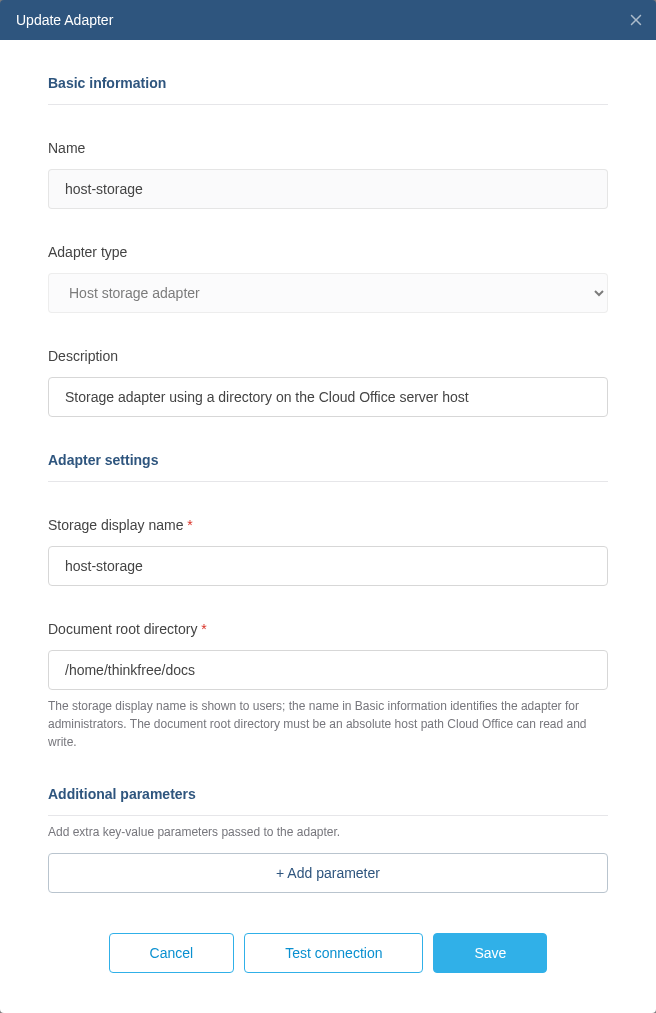
Sign in to the Office admin page and find host-storage under External linkage.
Click the Update icon in its row to check the document root directory and storage display name.
Create a document URL for the preconnected adapter
A document URL combines the Office address, registered adapter name, and relative path under the document root. Use the following URL format to open a Word document in the editor.
{OFFICE_URL}/cloud-office/api/{ADAPTER_NAME}/{DOCUMENT_PATH}/open?app=WORD_EDITOR&user_id={USER_ID}&docId={DOCUMENT_ID}
Use the Name shown in the admin page for ADAPTER_NAME.
The Storage display name is not used in the URL.
For DOCUMENT_PATH, use the relative path without the document root directory.
This example uses the adapter name host-storage and document root /home/thinkfree/docs shown above. If this directory contains sample.docx, use the following values.
| Field | Value |
|---|---|
| Office address | http://localhost:8080 |
| Adapter name | host-storage |
| Document root directory | /home/thinkfree/docs |
| File inside the container | /home/thinkfree/docs/sample.docx |
| Document path in the URL | sample.docx |
http://localhost:8080/cloud-office/api/host-storage/sample.docx/open?app=WORD_EDITOR&user_id=local-user&docId=hostsample001
Replace user_id with your user identifier and docId with a unique value identifying the editing session.
If your Office address or port differs, update the beginning of the URL as well.
See Create document URLs for app values for other document formats and a JavaScript URL builder.
Mount a document directory
The /home/thinkfree/docs directory used above contains sample documents inside the container. It is separate from the document folders on the host computer running Docker.
To open documents stored on the host computer in Office, you must mount their folder at /home/thinkfree/docs inside the container.
The following Linux example connects a user's /home/username/personal-documents folder. Replace this with the absolute path to your document folder, and check that the folder exists and Office has read and write access.
Add the following option to your Office run command when creating the container.
-v "/home/username/personal-documents:/home/thinkfree/docs"
The path to the left of the colon (:), /home/username/personal-documents, is the folder on the host computer. The path to the right, /home/thinkfree/docs, is where Office accesses that folder inside the container.
Keep Document root directory set to /home/thinkfree/docs in the admin page.
While the folder is mounted, this path shows the host folder's documents. The image's sample documents are not automatically copied into the host folder, so mounting an empty folder also leaves the samples unavailable at this path. Edits saved in Office are written to the files in the mounted host folder.
Document URLs for the mounted directory
With this mount, /home/username/personal-documents/contracts/Proposal 2026.docx on the host computer
appears as /home/thinkfree/docs/contracts/Proposal 2026.docx inside the container.
Because you are using the preconnected host-storage adapter, use contracts/Proposal 2026.docx, the path relative to the document root, in the URL.
http://localhost:8080/cloud-office/api/host-storage/contracts/Proposal%202026.docx/open?app=WORD_EDITOR&user_id=local-user&docId=hostproposal001
Preserve / between directories and URL-encode each path segment, such as %20 for spaces in the example above.
Do not include the host path /home/username/personal-documents or the container document root /home/thinkfree/docs in the URL.
Add another Host Storage adapter
To use the preconnected host-storage adapter, change only the host directory mount as shown above.
To connect another document directory through a separate adapter, mount that directory and register an adapter as follows.
To add a separate adapter for another directory, enable new registrations by adding the following option to your Office run command.
Host Storage can access files and directories on the server running Office. For security, new Host Storage adapter registrations are disabled by default. Enable them explicitly with the following option when starting the service.
-e TFO_ADAPTER_HOST_STORAGE_ENABLED=true
The screenshot below shows the admin page with new registrations enabled.
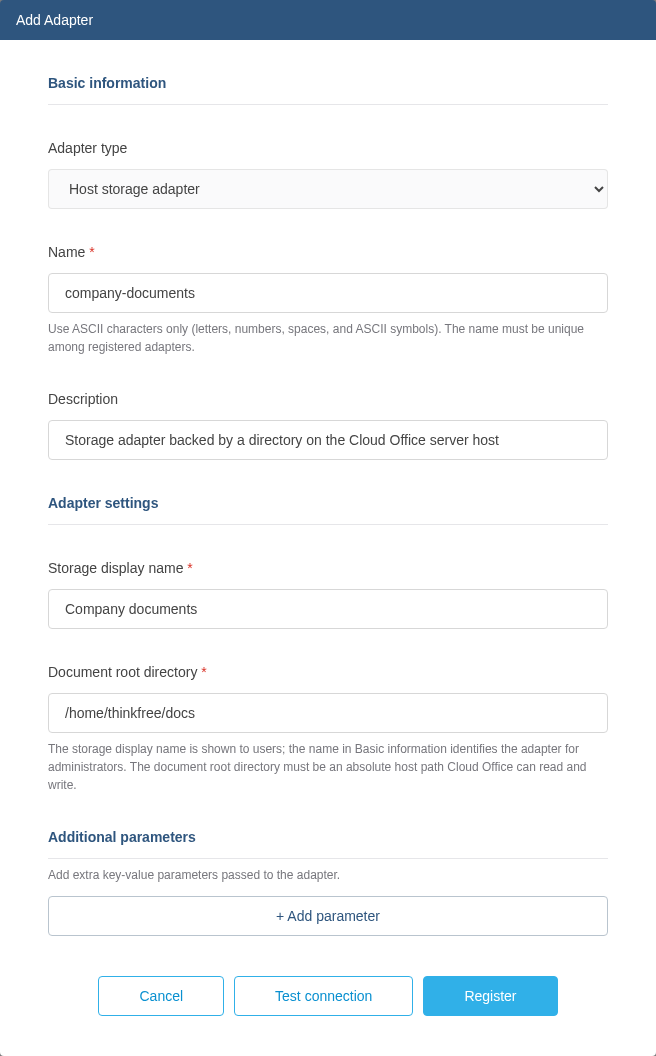
- Under External linkage, click Add Adapter.
- Select Host storage adapter as the Adapter type.
- Enter the following values.
| Field | Value to enter |
|---|---|
| Name | A unique adapter name for document URLs. Example: company-documents |
| Description | What the adapter is used for |
| Storage display name | The storage name shown to users. Example: Company documents |
| Document root directory | An absolute path that Office can read and write. Example: /home/thinkfree/docs |
- Click Test connection to check that Office can access the directory and list its files.
- If the test succeeds, click Register and check that the adapter is running in the list.
If the connection test fails, check that Office can access the specified path. When using a container, distinguish the host path from the path inside the container.
If you registered company-documents with document root /home/thinkfree/docs as described above, open sample.docx in that directory with the following URL.
http://localhost:8080/cloud-office/api/company-documents/sample.docx/open?app=WORD_EDITOR&user_id=local-user&docId=companysample001
The relative path remains sample.docx, while the adapter name in the URL changes to the registered name. See Create document URLs for all URL options.
Document URLs for an adapter connected to another directory
For example, to connect /home/username/work-files on the host computer as a separate document directory, add the following mount option to your Office run command. Replace the path on the left with your actual host folder.
-v "/home/username/work-files:/home/thinkfree/team-documents"
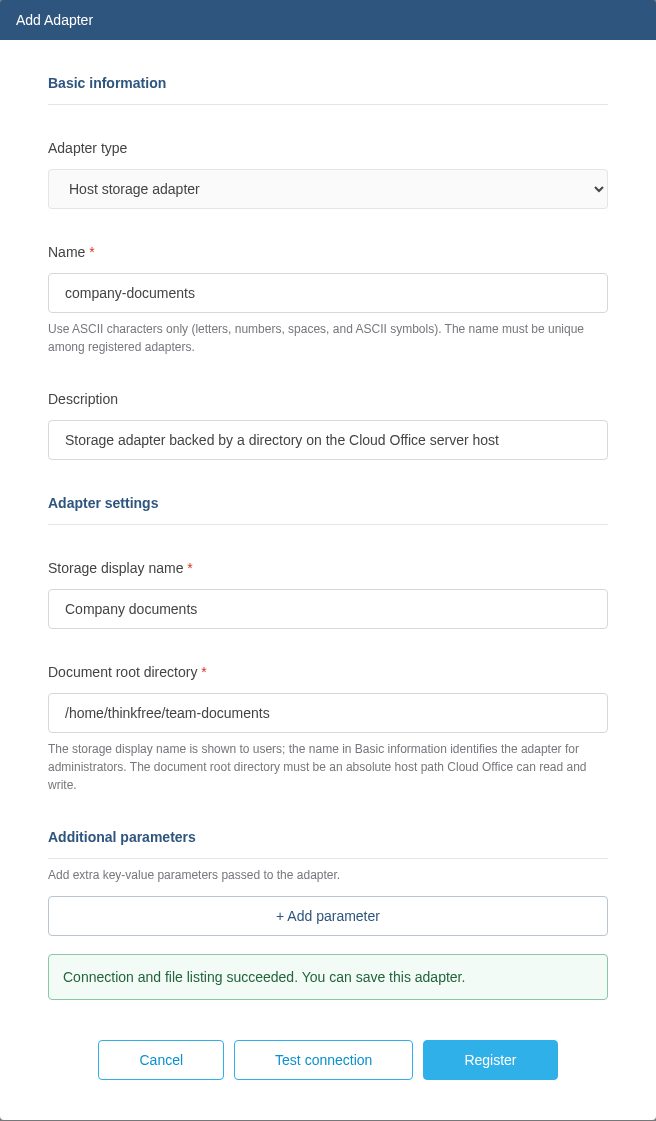
Enter the following values during registration. In this example, change Document root directory to the newly mounted path.
| Field | Value |
|---|---|
| Name | company-documents |
| Storage display name | Company documents |
| Document root directory | /home/thinkfree/team-documents |
| File on the host computer | /home/username/work-files/reports/Quarterly Report.docx |
| Document path in the URL | reports/Quarterly Report.docx |
The screenshot below shows these values after a successful Test connection. Click Register to add the adapter.
After registration, open the document with the following URL.
http://localhost:8080/cloud-office/api/company-documents/reports/Quarterly%20Report.docx/open?app=WORD_EDITOR&user_id=local-user&docId=companyreport001
Use the new adapter name company-documents and the relative path under its document root.
If you changed only the document root of the preconnected adapter, keep the adapter name host-storage and use the relative path under the updated root.
Verify opening and saving documents
Follow the examples above to create a document URL for an actual file and open it in your browser. Edit and save the document, then reopen it to check that your changes persist.
Browse documents in the admin page
Check that company-documents is running in the adapter list under External linkage.
Click the folder-shaped Browse files button next to the adapter name.
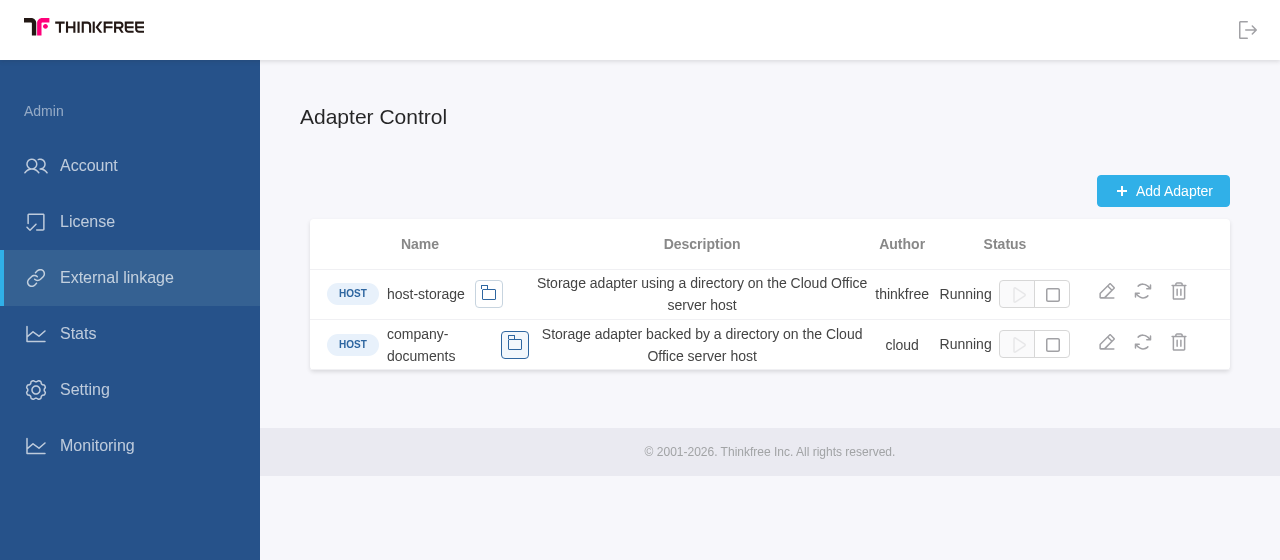
Select a directory in File browser to open it.
Select the reports directory in this example to find Quarterly Report.docx.
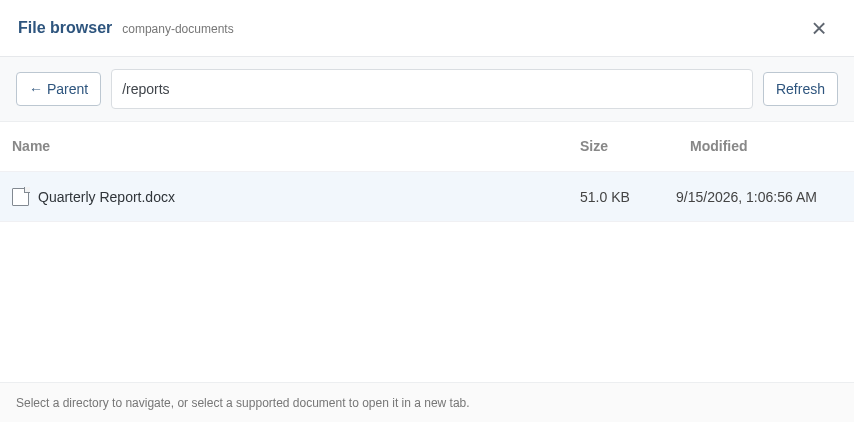
Click an Office document to open the Office editor in a new tab.